






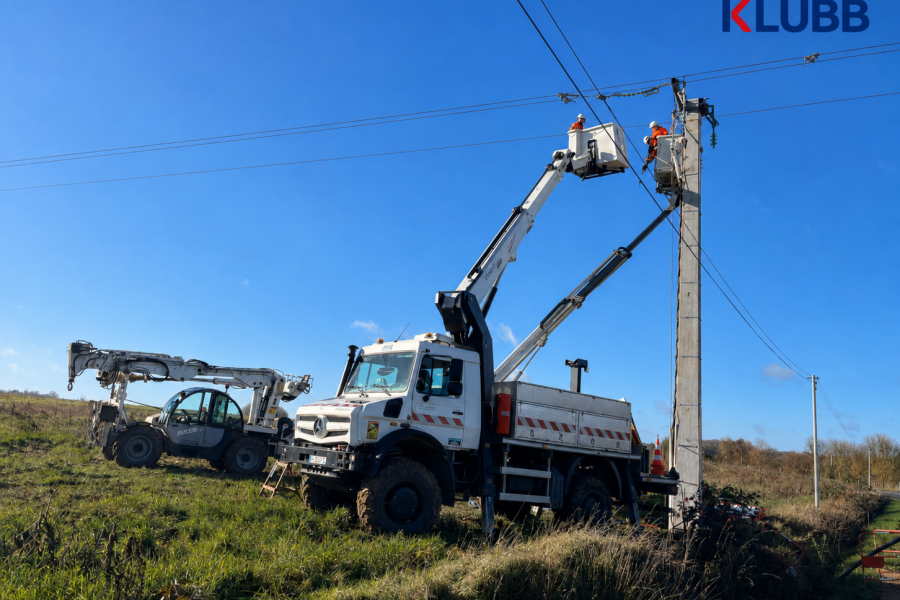
Using an insulated aerial work platform near a power line requires careful preparation from the initial site assessment stage. This means carrying out the evaluation before selecting the machine, deciding where it will be positioned and defining the working method.
This preliminary assessment is essential because the operation may expose workers to several hazards. One of the most obvious is direct contact with an electrical conductor. However, an electric arc or flashover can also occur without physical contact when the boom, platform, tool or operator enters a hazardous area.
Your assessment must therefore cover the entire operation, from the vehicle’s arrival on site through to the complete stowing of the aerial platform.
Start by defining the nature of the work
First, you should distinguish between work carried out in the vicinity of a power line and work performed on the electrical installation itself. These two situations are not subject to the same safety distances, competency requirements or operating procedures.
Article R4544-12 of the French Labour Code defines non-electrical work as operations carried out in the vicinity of electrical equipment or installations without involving their conductive parts. Construction, operation and maintenance work on electricity distribution networks is governed by a separate regulatory framework.
Information note: An insulated aerial work platform may form part of the technical equipment used for live working, but it does not replace the working method, authorisations and safety instructions defined for the electrical installation concerned.
Identify all power lines before positioning the aerial platform
You must then identify every power line located around the worksite. Your site survey should cover the working area, the vehicle access route, the planned parking position and the entire space through which the boom may travel.
Bear in mind that a high-voltage line may be concealed by a building, tree or piece of equipment. It may also be located behind you, beside the machine or below the level of the platform once it has been raised.
During the preparatory discussions, the network operator or the person responsible for the installation must provide the information required for your assessment. This should include the network configuration, its route, the height of the power lines and their voltage range.
| Information to obtain | What it helps you prepare |
| Network configuration | Identify the type of power lines and equipment present |
| Conductor route | Define the access and working areas |
| Power line height | Plan the movement of the boom and platform |
| Voltage range | Determine the applicable safety distances and protective measures |
| Electrical status of the installation | Confirm the conditions under which the work will be carried ou |
Do not assume that a conductor is safe simply because it is covered by a sheath. Some protective coverings are designed only to protect the cable from damage and do not provide electrical insulation that would allow workers or equipment to approach or touch it safely.
Author Attribution
Have the electrical status of the network confirmed
The colour, appearance or age of a power line does not indicate whether it is energised. Until its status has been confirmed by the person responsible for the network, you must treat it as energised by default.
When de-energisation forms part of the selected safety measures, obtain formal confirmation before starting work. At this level of risk, you must never assume that the network has been switched off or take action before its status has been verified.
If you are unable to identify the line, its voltage or the applicable working conditions, do not deploy the aerial work platform. Report the situation to the site manager and wait for further instructions.
Determine the applicable safety distances
For non-electrical work carried out near bare, energised overhead power lines, the French Order of 5 July 2024 establishes two general safety distances.
- Less than or equal to 50,000 V : 3m
- Greater than 50,000 V and less than or equal to 500,000 V : 5m
These distances apply not only to operators, but also to vehicles, work equipment, suspended loads and handled materials. They must be assessed from the part of the aerial platform, equipment or load that could come closest to the conductor.
We would also like to emphasise that these distances do not define the conditions for carrying out live electrical work. Such operations are governed by the distances, techniques and procedures specific to the work performed on the electrical installation.
You must also account for any possible movement of the aerial platform and the equipment being carried. Wind, conductor expansion, boom movement or the whipping and swinging of materials can reduce the clearance initially estimated from ground level.
Assess the entire working envelope
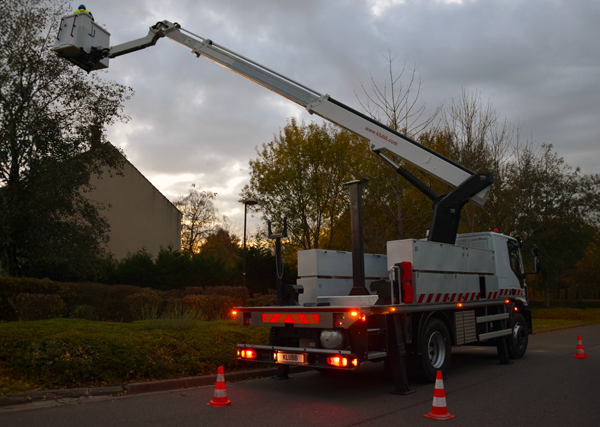
The final position of the platform alone is not sufficient to assess the risk. Before starting work, consider the entire space through which the boom, platform and tools may move.
This working envelope includes lifting, outreach, turret rotation and platform orientation. You must also account for the length of poles, cables, tools or components that will be handled from the platform.
The clearance from the power line must remain controlled throughout every movement. IPAF recommends selecting the aerial work platform on the basis of its working envelope and confirming that no part of the machine can enter a hazardous area.
Where the site configuration allows, approach the working area in two stages. First, raise the platform to the required height in a clear area, then move towards the work position using short, controlled movements.
Prioritise positioning over maximum outreach
The position closest to the installation is not always the most suitable. Select a location that allows you to reach the working area without moving the boom, platform or tools through a hazardous space.
An aerial work platform with greater outreach may help keep the carrier vehicle at a safe distance or allow the boom to pass over an obstacle. However, it also increases the area swept by the boom. Outreach must therefore be assessed using the machine’s working envelope diagram and the planned vehicle position on site.
Where site conditions allow, positioning the vehicle perpendicular to the power line may also make it easier to control the clearance. This arrangement remains dependent on ground conditions, the space available for the stabilisers and the operating limits specified by the manufacturer.
Select an aerial work platform suited to the operation
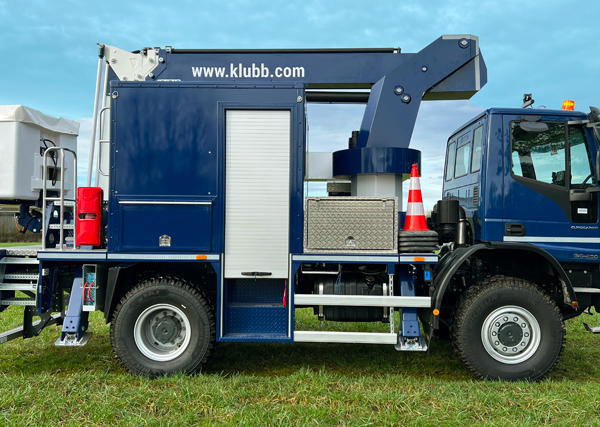
For work performed at a safe distance from the network, a non-insulated aerial work platform may be suitable when the risk assessment confirms that the required clearances will be maintained. For live working, use an insulated aerial work platform rated for this application and compatible with the procedures established for the electrical installation.
Do not rely solely on the presence of a platform made from composite material. On an insulated aerial device, the level of protection depends on several components, including the insulating boom sections, any liners, the equipment markings and the machine configuration. Its electrical rating must be clearly identifiable on the equipment.
Working height and outreach remain essential selection criteria, but they must be considered alongside platform load, stabilisation and the complete working envelope. The most suitable aerial work platform is not necessarily the one that reaches the greatest height, but the one that allows the work area to be approached from a controlled position.
Select an aerial work platform suited to the operation
For work carried out at a safe distance from the network, a non-insulated aerial work platform may be suitable when your assessment confirms that the required clearances will be maintained. For live working, use an insulated aerial work platform rated for this purpose and compatible with the procedures established for the electrical installation.
Do not rely solely on the presence of a platform made from composite material. On an insulated aerial device, the level of protection depends on several components, including the insulating boom sections, any insulating liners, the equipment markings and the machine configuration. The electrical rating must be clearly identifiable on the equipment.
Working height and outreach remain essential selection criteria, but they must be considered alongside the carried load, stabilisation and the complete working envelope. The most suitable aerial work platform is not necessarily the one that reaches the greatest height, but the one that allows you to approach the work area from a controlled position.
Check the ground conditions and stabilisation
Before deploying the stabilisers, confirm that the ground can withstand the forces transmitted by the vehicle. Identify slopes, weak verges, backfilled areas, trenches, manholes and slabs whose load-bearing capacity is unknown. In other words, identify anything that could affect the vehicle’s stability.
Extending the boom shifts the machine’s centre of gravity. Incorrect levelling, insufficient support or ground subsidence can compromise its stability and alter the path of the platform.
You must also comply strictly with the slope and inclination limits specified in the manufacturer’s operating manual. Use suitable spreader pads where ground conditions require them, and never position a stabiliser on a structure whose load-bearing capacity is unknown.
The French Labour Code also requires the condition and gradient of the ground to be taken into account in the working method, alongside the maximum height of the equipment, visibility conditions and access for emergency services.
Weather conditions must also be considered
Weather conditions are sometimes overlooked, but they can reduce your safety margins during the operation.
Wind, for example, can move conductors, cause the platform to sway or alter the path of tools. Temperature changes can affect conductor sag and therefore its actual height above the ground.
Do not wait until the manufacturer’s maximum wind-speed limit is reached before stopping work if you can no longer control the clearances or maintain adequate visibility. Your risk assessment must remain dynamic and be reviewed whenever conditions change.
Protect the work area from traffic
It cannot be stressed enough that clearly defining and securing the work area is essential. Barriers, traffic restrictions and designated routes must cover the entire area in order to protect both the work team and other road users.
The unexpected arrival of a vehicle or pedestrian could disrupt the operation and expose you to a greater risk of electrocution or other hazards.
Where equipment passing beneath a power line could breach the applicable safety distances, the site organisation must prevent such movement or provide suitable height-restriction and clearance-control devices. Regulations also require the areas that vehicles and equipment must not enter to be clearly marked.
Check the condition of the aerial work platform before use
Carry out all inspections specified by the manufacturer before each operation. Check the controls, emergency stops, emergency lowering system, stabilisers, hydraulic systems, boom and platform.
On an insulated aerial work platform, additional safety checks must be carried out alongside the standard inspections. These include checking:
- the validity of the electrical test certificate;
- the validity of the boom’s insulation rating;
- the legibility of all markings;
- the correct operation of the safety devices.
Operator familiarisation with the machine must cover all these points before it is put into service.
Insulating surfaces must be kept clean and must show no cracks, impact damage or contamination that could impair their electrical properties. A visual inspection does not replace the periodic testing required by the manufacturer or by the applicable procedures.
If any defect or abnormality is identified, do not continue the operation. Remove the machine from service until its condition has been assessed by a competent person.
Assign a trained person on the ground
We support the recommendations issued by the French National Research and Safety Institute, INRS, regarding the importance of having a ground-based operator who understands how the aerial work platform functions. This person can guide the operator in the platform, monitor the surrounding area, alert the emergency services and operate the machine from the lower control station.
Where maintaining the required clearances makes it necessary, the employer must appoint an electrical safety observer. Their role is to ensure that workers do not cross the boundary of the designated working area and to warn them if a hazard arises.
These two roles may be performed by the same person, but they should not be confused. Anyone responsible for monitoring the clearance from the power line must remain focused on that task and must not carry out another activity at the same time. They must also understand the machine’s working envelope and its emergency lowering procedures.
Before deploying the aerial platform, define the communication method that will be used with the operator. Where verbal instructions or hand signals are insufficient, provide a radio system and establish clear instructions understood by everyone involved.
Check the competence of everyone involved
Operating an aerial work platform and managing electrical hazards require different skills. A person may be qualified to operate a MEWP without being authorised to work on an energised electrical installation.
Make sure that the operator has received the required training and holds the operating authorisation issued by their employer. The person on the ground must also understand how the machine works and how to perform emergency lowering procedures.
For live electrical work, everyone involved must hold the authorisations, training and instructions appropriate to the operation being performed. The presence of an insulated aerial work platform does not, by itself, authorise anyone to work on the network.
Before each operation, also confirm that the team understands the working method, the clearances that must be maintained, the actions to take in the event of electrical contact and the conditions under which work must be stopped.
Prepare the emergency procedure
Your emergency procedure must be established before the platform leaves the ground. It should specify who is authorised to use the lower controls, how movements can be stopped and how the occupants can be returned to a safe position.
Keep access to the emergency control station clear. The designated person must be familiar with the model being used, its lowering systems and the limitations of each emergency procedure. IPAF includes the rescue plan and communication system among the elements that must be prepared before work begins.
You must also define the actions to take in the event of electrical contact or flashover. In such a situation, treat the entire machine as energised. Prevent anyone from approaching or touching the vehicle until the network operator has confirmed that the hazard has been removed.
Tyres or tracks do not mean that the aerial work platform is electrically isolated from the ground. Touch voltage may develop on the machine, while step voltage may occur in the surrounding area.
Prepare the worksite before selecting the machine
Work near a power line cannot be planned on the basis of working height alone. You must consider the network, the applicable clearances, the ground conditions, the working envelope, the team’s competence and the available emergency arrangements as part of the same assessment.
Only once this analysis has been completed should you select the appropriate aerial work platform. For live working, confirm that the machine’s insulated configuration, electrical rating and conditions of use are compatible with the selected working method.
At KLUBB, we can help you assess your requirements and select an insulated aerial work platform suited to your live electrical work. Our teams will review the access conditions, working height, outreach and the specific constraints of your operations with you. KLUBB brochures identify these machines as aerial work platforms intended for live working and specify their electrical and operational characteristics.